
We Asked Our CEO the AI Questions Every CTO Is Asking
Key takeaways
- The biggest opportunity with AI is not just speed and efficiency, but creating better products, services, and business value.
- Strong engineering expertise matters more than ever as AI accelerates software development.
- AI agents can become part of everyday software development, helping teams deliver more features with better quality.
- Human control does not mean approving every action. It means setting clear boundaries and knowing when human judgement is needed.
- Observability is fundamental to giving AI agents greater autonomy without losing transparency or control.
- The long-term competitive advantage comes from building AI as an organisational capability, not simply having access to AI tools.
AI is changing how software is built, but its biggest opportunity goes beyond writing code faster or reducing development costs. It is about creating better products, improving quality, and delivering greater business value.
As AI agents become part of everyday software development, strong engineering expertise, observability, and human control become increasingly important.
So we asked our CEO, Rami Rantala, 10 AI questions every CTO should be thinking about. From business value and engineering principles to AI agent autonomy, human control, and the future of software development, Rami shares his perspective on how organisations can turn AI into a real business capability while building reliable and trustworthy software.
1. Rami, with all the attention around AI right now, what should technology leaders really be focusing on?
For me, it comes down to one thing: focus on the value AI creates.
AI is changing how software is built. AI roles are becoming part of development teams, and people and AI are increasingly working side by side. But the biggest opportunity is not simply to do the same things faster or cheaper. It is to create something better than before.
We already see this with one of our customers, where AI agents work as part of the software development team. The team can deliver more features with better quality, supported by more testing and recorded videos that show users what has changed. These are things that were previously difficult to include consistently in the development process.
There are still unknowns with AI, but they can be managed with the right experience and way of working.
So the first question I would ask is simple: What new value can this help us create?
Start there, and efficiency becomes one part of a much bigger opportunity.
2. You say “focus on the value”. But most people talk about speed and efficiency. What are they missing?
Speed and efficiency are important, but they become much more valuable when they also lead to better quality, better services, or new capabilities.
There is also a bigger shift happening in software development. As AI takes care of more of the coding, understanding the business becomes increasingly important.
Someone still needs to understand what the customer needs, what can realistically be achieved, and what kind of solution makes sense. That moves more of the developer’s value towards designing the right solution, understanding the bigger picture, and solving the right problem.
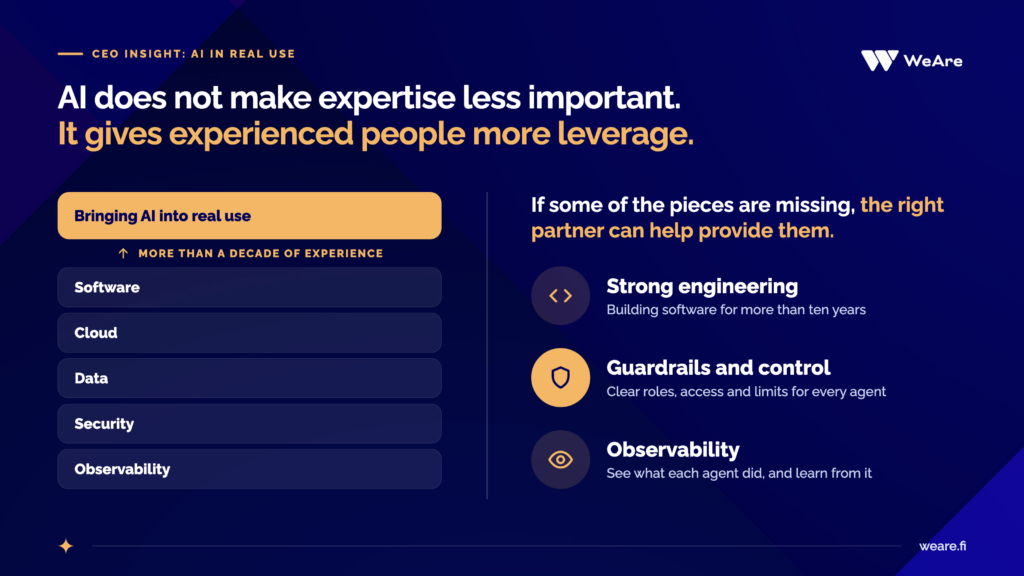
I see that as a positive change. AI does not make expertise less important. It gives experienced people more leverage.
So before asking, “What can we automate?”, I would ask: “What can we improve?”
3. If AI is making software development faster and more accessible, how does that change the importance of good engineering?
I think it matters more than ever.
It is exciting that AI makes it possible to create applications so quickly. But creating something quickly and creating something that works reliably for years are two different things.
A good solution still has to be useful, secure, scalable, and maintainable.
Security, scalability, maintainability, and good architecture do not disappear because development gets faster. They are what allow you to take advantage of that speed safely.
The real opportunity is to combine the speed and flexibility of AI with strong engineering principles.
That is how fast experimentation becomes reliable software.
4. From your experience of integrating AI agents into one of our customers’ software development processes, what has surprised you most about the value they can create?
For one of our customers, AI agents now work alongside developers as part of the normal software development workflow.
The interesting part is not only that work can happen faster. The team can deliver more features with better quality, with more testing around each feature. New features can also come with recorded videos showing users what has changed.
Previously, there was rarely enough time to make those things a consistent part of every feature. AI has made them much easier to include.
That is a good example of the kind of value I find interesting. You are not simply removing work. You are improving what the team is able to deliver.
And AI is no longer a side experiment. It has become part of how the team works every day.
You can learn more about the case study here.
5. As AI agents take on more responsibilities, what needs to be in place before companies can confidently use them in production?
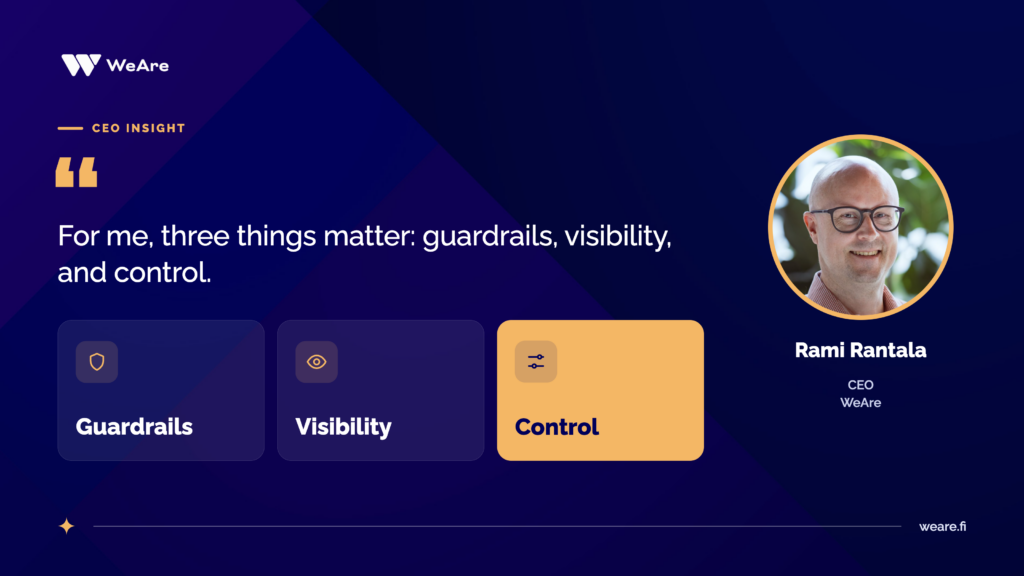
For me, three things matter: guardrails, visibility, and control.
Every AI agent should have a clear role, the right level of access, and well-defined limits. It should be able to reach what it needs to do its job, but not everything.
The same principle applies to data. Sensitive information needs to be handled deliberately, for example through restricted access or anonymisation where appropriate.
And you need to know what is happening. The team should be able to see what was done, which agent did it, under which identity, and what happened along the way.
These are not obstacles to adoption. They are what make it possible to use AI confidently in production and expand its responsibilities over time.
6. Do you think human approval of every AI agent action will eventually become a limitation rather than a necessity?
That is actually where my own thinking has changed.
I used to believe a person should approve every action an AI agent takes. But the more I thought about it, the more I started comparing it to leading a company.
I do not personally approve every decision someone at WeAre makes. People have clear responsibilities and boundaries, and I rely on the right information and tools to understand what is happening.
I think AI agents can increasingly work in the same way.
Routine work can happen independently when roles, permissions, and limits are clearly defined. Important rules can be enforced by the system itself, while decisions involving production, product judgement, or greater business impact remain with people.
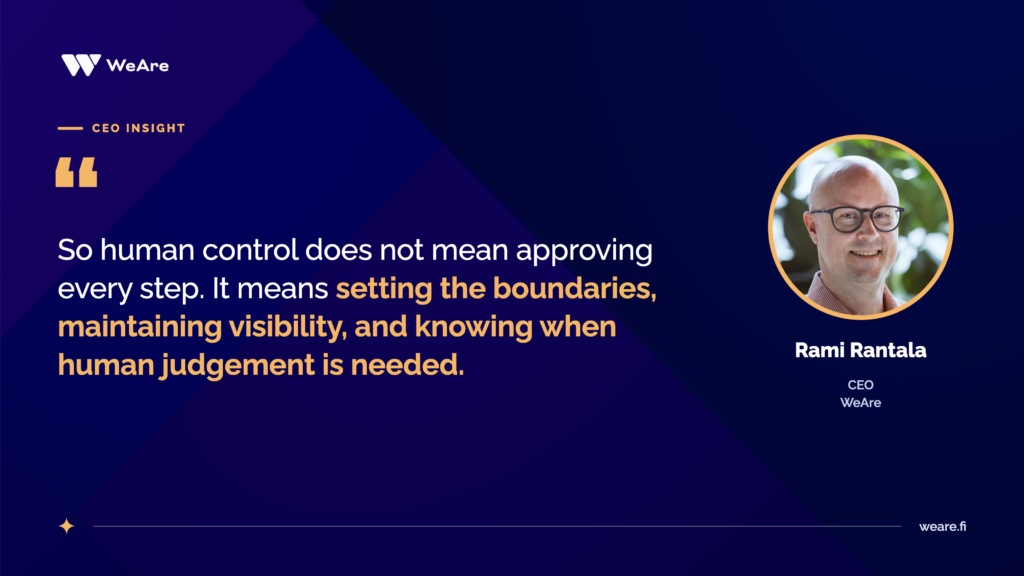
So human control does not mean approving every step. It means setting the boundaries, maintaining visibility, and knowing when human judgement is needed.
7. If we give AI agents more autonomy, how do we maintain visibility and control over what they are actually doing?
This is where observability becomes fundamental.
As agents take on more work, companies need a clear record of what happened: what the agent did, which agent acted, under which identity, and how the process progressed.
Logging and monitoring provide that visibility.
But observability is not only there for failures. It also helps teams understand how agents behave, identify where they can improve, and learn from real usage.
The more responsibility we give AI, the more important it becomes to understand its actions.
For me, that is what makes greater autonomy possible without losing transparency or control.
8. If every company eventually has access to the same AI models and tools, where will the real competitive advantage come from?
The difference will be how well companies learn to use AI as part of the organisation.
Models and tools will continue improving and becoming widely available. Access alone will not create a lasting advantage.
We have seen the same pattern with data, cloud, and DevOps. Most companies eventually adopted the technology, but the leaders were the ones who built real capability around it.
I expect AI to follow the same path.
The advantage will come from how well AI is integrated into daily work, processes, and products, and how quickly the organisation learns from each use case.
I think of AI as an organisational capability. And the good thing is that it can be built step by step.
9. If a company wants to introduce AI into its software development process but does not know where to begin, what would you recommend?
I would start by looking at how software development works in the organisation today and identifying where AI could make a meaningful difference.
There is no need to transform the entire development process at once. Start with a well-defined use case, introduce AI within a manageable scope, and learn from the results before expanding its responsibilities.
I also think companies sometimes underestimate what they can achieve because they assume they need to build all the AI expertise internally before getting started.
That is not necessarily the case. The customer understands their business, products, and development needs. An experienced technology partner can bring the engineering expertise needed to turn those needs into practical solutions.
You do not need to have all the answers before getting started. What matters is choosing the right starting point and having the right expertise to move forward.
10. Last question. Five years from now, what do you think we’ll look back on and realise we misunderstood about AI and software development?
My best guess is that we will realise we focused too much on whether AI would replace developers and not enough on how the role itself would change.
I expect writing code by hand to become a much smaller part of software development. But I do not believe engineering expertise disappears.
Someone still needs to understand what should be built, what is possible, how systems should work together, and how business needs should be translated into good solutions.
So I think expertise moves to a higher level. People spend less time on manual implementation and more time designing, guiding, and making the right decisions.
I also find it fascinating to think about what happens to software itself. Today, AI agents still work with programming languages we recognise. In the future, perhaps there will be new languages or ways of building software designed primarily for agents.
Whatever form that takes, one thing will remain important: we need to understand what has been done and be able to trust the result.
AI in software development is still at the beginning, and I think the most interesting changes are still ahead of us. I am genuinely looking forward to seeing where it goes.
At WeAre, we are already helping customers bring AI into real use, and our more than a decade of experience across software, cloud, data, security, and observability gives us a strong foundation for that work. The technology may change quickly, but that technical experience helps us understand how to build AI solutions that can work reliably in the real world.
Is your AI moving into production?
If your organisation is introducing AI applications or agents and you are asking what to monitor, how to connect the data, or how Splunk can support the environment, let’s talk.
Tell us what you are building, and we’ll help you identify the right next step.
Facebook
Twitter
LinkedIn