
We Asked Our Field CTO the AI Observability Questions Every CTO Should Be Asking
Key takeaways
- Technical health does not always mean AI is delivering the right result.
- AI observability should connect models, tools, applications, and infrastructure.
- More data does not automatically mean more understanding.
- AI cost should be measured together with quality and task success.
- AI agents need clear boundaries, visibility, and human intervention points.
An AI application can be online, fast, and technically healthy, and still give the wrong answer, take the wrong action, or cost far more than expected.
That means monitoring can no longer stop at uptime, latency, and errors. Teams also need to understand whether the AI is actually doing the right thing and delivering the intended result.
So we asked our Field CTO for Observability, Jonas Koponen, 10 questions about what changes when AI moves into production. From monitoring agent behaviour and cost to human control, business outcomes, and the role of Splunk, Jonas explains what companies need to see, measure, and understand as AI becomes part of real applications and workflows.
1. Jonas, companies already monitor their applications today. What actually changes when AI becomes part of the system?
The foundations stay the same. We still need to understand availability, latency, errors, and the health of the application and infrastructure.
What AI adds is another layer of questions.
Was the answer useful and accurate? Did the agent take the right actions? And what did completing the task actually cost?
A support agent might respond quickly, without any technical errors, but give the customer an outdated refund policy. The technology is running, but the result is wrong.
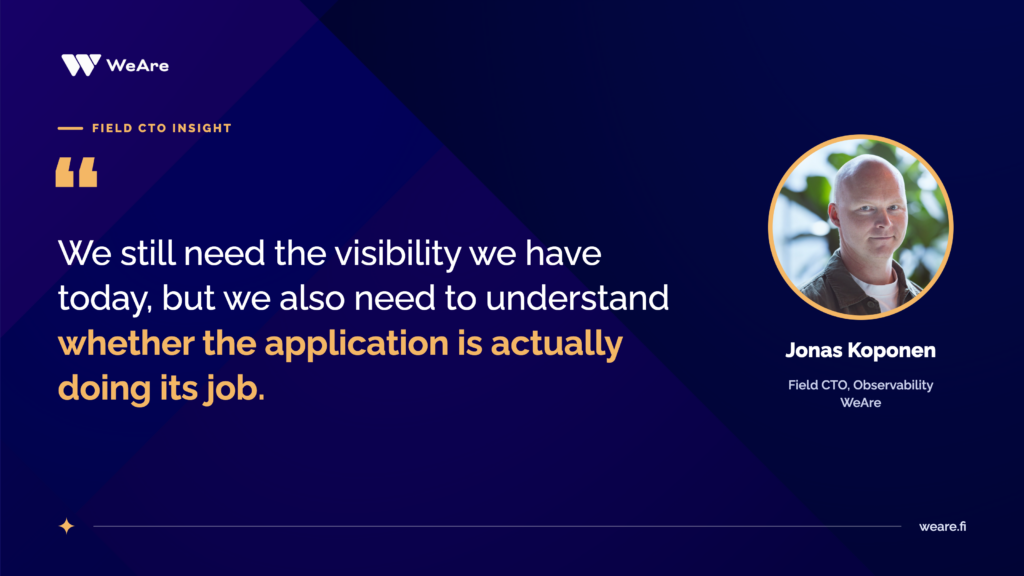
That is what changes. We still need the visibility we have today, but we also need to understand whether the application is actually doing its job.
2. So an AI application can technically be working perfectly and still be failing?
Exactly.
An application can be online, respond successfully, and look healthy from a traditional monitoring perspective, while still giving an incorrect answer or taking an inappropriate action.
That is not completely new. We have always had applications that were technically available but did not deliver a good customer experience. AI adds more ways for that to happen.
A successful API response does not tell you whether a customer’s problem was solved.
So we need to define what success looks like for the task. For a support assistant, that could mean resolving the issue and following the correct policy. Response time still matters, but it does not tell the whole story.
3. Once AI starts making decisions or taking actions, what new questions should teams be able to answer?
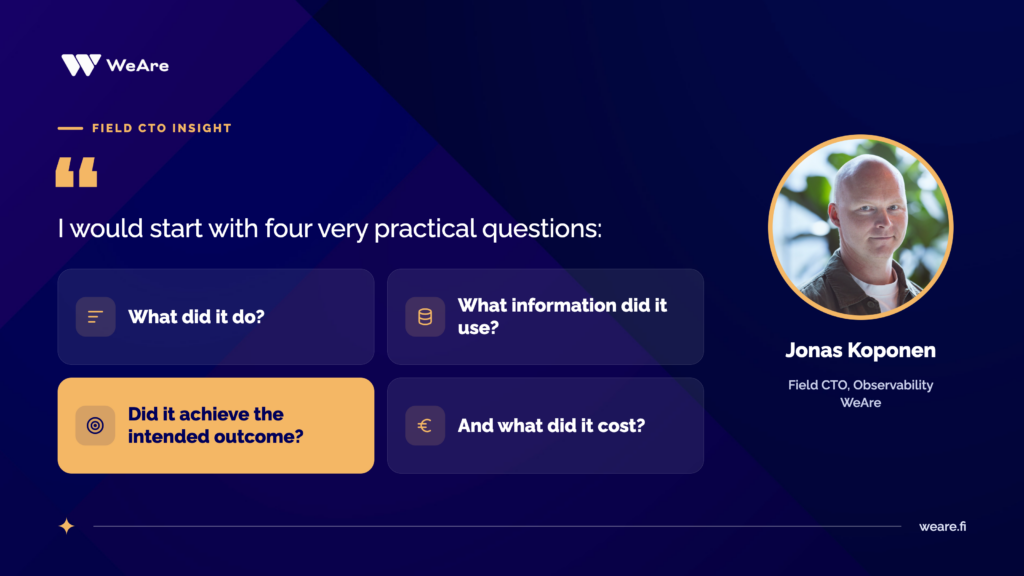
I would start with four very practical questions:
What did it do? What information did it use? Did it achieve the intended outcome? And what did it cost?
Then there is the human side. Who is accountable, and when should a person approve, intervene, or stop the process?
An agent recommending a refund is one thing. An agent actually issuing that refund is another. The permissions and approval requirements need to reflect that.
You do not necessarily want a human approving every small action. But you do want clear boundaries, a record of what happened, and a way for someone to step in when needed.
4. What can go wrong quietly if that visibility is missing?
Quite a lot can happen without causing a traditional technical alarm.
An agent might close a support case before the issue is resolved. It might keep calling a tool without making progress. Or it might use outdated information and produce an answer that sounds very convincing.
From the outside, the application may still look healthy.
That is why we need to look for things like repeated attempts, unresolved tasks, unexpected actions, and costs building up in the background.
And when something does go wrong, we need enough context to investigate it. Otherwise, we are left trying to work backwards from a customer complaint or an unexpectedly large bill.
5. Does that mean good AI observability is simply about collecting more data?
No. More data does not automatically mean more understanding.
The starting point should be the question we are trying to answer.
If an AI application produces a poor result, we may need to see what information it received, which model and prompt version it used, and what happened when it called a tool.
But seeing those steps does not, by itself, tell us whether the answer was good. We also need a way to evaluate the result. That might be checking it against a business rule, looking at whether the task succeeded, or asking a person to review it.
We also need to be sensible about what we collect. Prompts and responses can contain sensitive information.
The goal is to bring together the evidence we need to understand and improve the system.
Want to go deeper into AI monitoring, token usage, cost, and Splunk? Read the full guide here.
6. So when something does go wrong, how does observability help you find the actual cause?
The value comes from being able to follow what happened across the workflow.
Take the support agent that gave a customer an outdated refund policy. The model may have used the information it was given correctly. Perhaps the retrieval system selected an old document, or the current policy was missing from the knowledge source.
If you can connect the answer to the information retrieved, the tool calls, and the services involved, you have somewhere useful to start.
You can then compare that run with one that worked and investigate what was different.
It does not mean you can see exactly why a model produced every word. But you can understand the steps around it and test where the problem came from. That makes the investigation much more practical.
7. As AI usage grows, how should companies think about performance, token usage, and cost alongside normal system health?
I think quality, speed, and cost need to be looked at together.
Token usage is useful because it helps explain where spending comes from. But it does not tell you whether that spending was worthwhile.
A more meaningful measure is the cost of completing a task successfully. That includes retries, tool calls, and any human work needed to correct the result.
A more expensive run may be perfectly reasonable if it gets the job done reliably. A cheap run that fails repeatedly may not be particularly efficient.
I would also look beyond averages. A few workflows going round in circles can create a lot of cost.
So the question is: What did we get for that cost, how long did it take, and how consistently can we deliver it?
8. Where does Splunk fit into all of this?
Splunk is useful because AI does not operate in isolation.
Around the AI activity, you have applications, APIs, databases, infrastructure, cloud services, and business workflows. If an agent produces a poor result, the cause could be anywhere along that path.
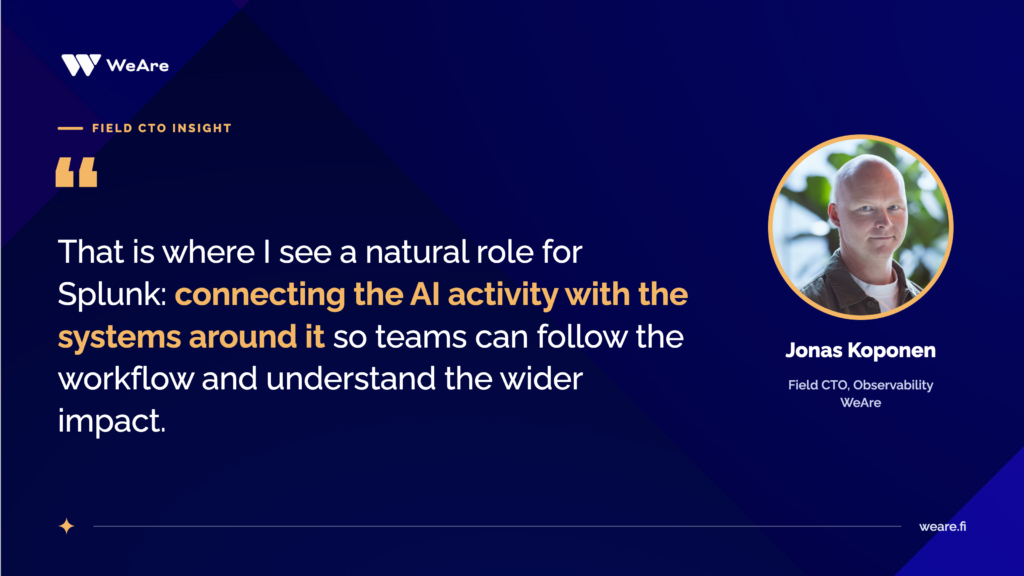
That is where I see a natural role for Splunk: connecting the AI activity with the systems around it so teams can follow the workflow and understand the wider impact.
Splunk Agent Observability also brings capabilities for agent workflow visibility, evaluations, and guardrails.
Those help with different questions: What happened? Was the result good? And where should we put controls in place?
The important thing is to connect those capabilities to the environment the organisation already depends on.
9. Before a company puts an AI-powered application into production, what would you want them to have in place from an observability point of view?
First, define what a good result actually looks like and how you will measure it.
Then test more than the happy path. Use representative cases, unusual inputs, tool failures, and situations where the system should fall back or ask for human help.
I would want the workflow to be traceable, so the team can investigate a problem and see which model, prompt, information, and tools were involved.
I would also want clear ownership. Who gets the alert? What should they do? When does a person need to approve an action, and how do we stop or roll back the system if necessary? Those things need to be tested before production.
And we need to check how sensitive information is handled in the telemetry.
The goal is to give the team enough visibility and control to operate confidently and improve as they learn.
10. Last question. Looking a few years ahead, how do you think observability itself will change as companies use more AI agents and models?
I think we will increasingly look at complete tasks and outcomes.
A single task may move across several agents, models, tools, and services. We will still need to understand those individual parts, but the bigger questions will be: Did the whole workflow succeed? What did it cost? Where did it struggle? And where did a person need to intervene?
I also expect production behaviour to become a more important source of learning.
If something fails in real usage, that should help us decide what to test next. Ideally, it becomes a case we check before making another change to the model, prompt, or workflow.
There will be more paths and dependencies to understand. But the question behind it is still very practical:
Is the application producing the results the business actually expects?
From AI monitoring to real observability
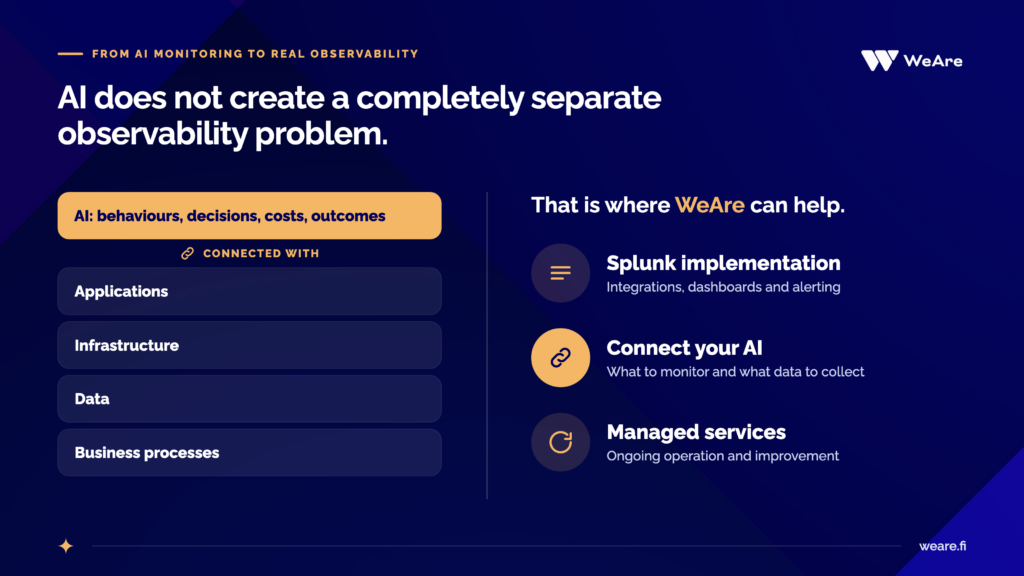
As Jonas points out, AI does not create a completely separate observability problem. It adds new behaviours, decisions, costs, and outcomes that need to be connected with the applications, infrastructure, data, and business processes already running underneath.
That is where WeAre can help.
We work with organisations to design, implement, and improve observability, from Splunk implementations and integrations to dashboards, alerting, full-stack observability, and ongoing managed services.
As AI becomes part of more applications, we can also help teams understand what needs to be monitored, what data should be collected, how AI activity connects to the wider environment, and how to build the visibility needed for production use.
Want to go deeper into observability?
Our Observability Playbook is a practical guide for technology leaders, IT operations, DevOps, platform teams, and business decision-makers.
It covers:
Observability fundamentals
Metrics, logs, and traces
Implementation challenges
Observability maturity
The role of AI in modern observability
If you want to understand how to move from traditional monitoring toward better visibility across technology and business outcomes, the Playbook is a good place to continue.
Is your AI moving into production?
If your organisation is introducing AI applications or agents and you are asking what to monitor, how to connect the data, or how Splunk can support the environment, let’s talk.
Tell us what you are building, and we’ll help you identify the right next step.
Facebook
Twitter
LinkedIn