
What Is Dark Data? Examples, Risks, and How to Use It
Dark data is information an organization collects, processes or stores but does not use for analytics, decision-making or operational improvement. It may be completely unknown, difficult to access, trapped in a silo or simply forgotten.
It accumulates as a byproduct of everyday business. Application logs, IoT measurements, old files, email archives, customer service recordings, backups and data left in retired systems can all become dark data.
In Splunk's State of Dark Data study respondents estimated that 55 percent of their organizations' data was dark. That does not mean every unused byte should be analyzed. The real task is to understand what data exists, what value or risk it carries, and whether it should be activated, retained securely, archived or deleted.
Dark data is not automatically valuable. Value appears only when an organization understands the data and makes a purposeful decision about it.
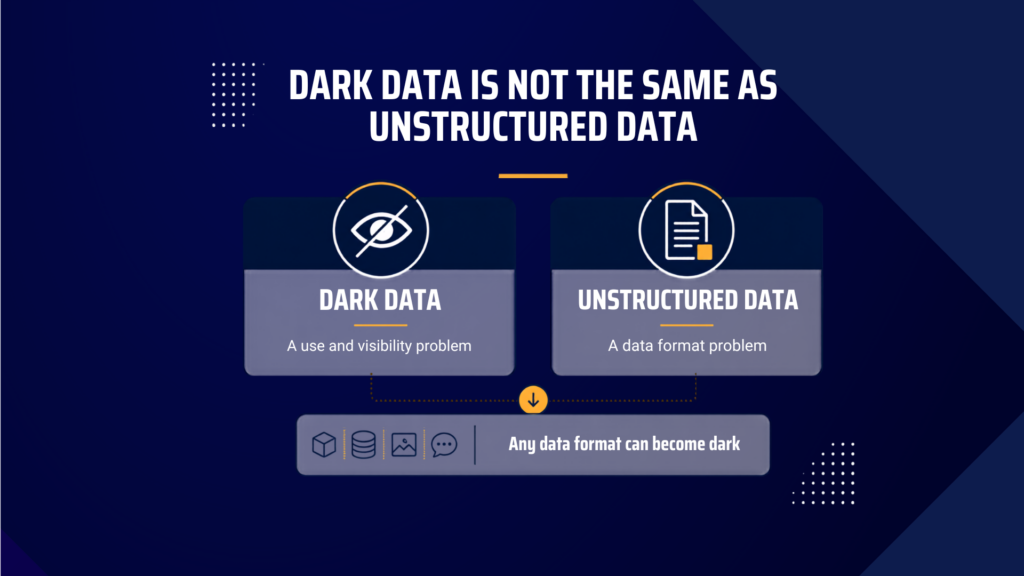
Dark data is not the same as unstructured data
Dark data is not a format. It is a state defined by limited visibility, understanding or use. Structured, semi-structured and unstructured information can all become dark.
| Term | What it means | Example |
|---|---|---|
| Dark data | Information that is collected or stored but not actively known, governed or used. | An archived server log that nobody searches or analyzes. |
| Unstructured data | Information without a fixed table or database schema. It can still be actively used. | Email, images, video or call recordings. |
| Poor-quality data | Incomplete, inaccurate, stale or inconsistent information. | A customer record with important fields missing. |
| ROT data | Redundant, obsolete or trivial information with little or no current value. | Several copies of an outdated report. |
Unstructured information can become dark data, but the terms are not interchangeable. A call recording that is actively transcribed and analyzed is unstructured data, but it is not dark. A well-structured database can be dark if nobody understands its contents or can access it for a valid purpose.
What are common examples of dark data?
Dark data looks different across organizations. Common examples include the following.
- Logs and technical telemetryApplication, server, network, security and audit logs that are collected but never indexed, correlated or monitored.
- IoT and sensor dataTemperature, energy, location, equipment and production measurements that are stored but never used to influence maintenance or operations.
- Customer interactions.Call recordings, chat transcripts, feedback, search terms, abandoned carts and events across the customer journey.
- Documents and communications. Emails, presentations, PDFs, notes and spreadsheets forgotten in shared drives or collaboration tools.
- Business applications. Fields in CRM and ERP systems that are collected by default but excluded from reporting and decision-making.
- Legacy systems and backups. Data left in retired applications, cloud storage or archives with no clear owner.
- Identity and access records. Information about who accessed a system, what they did and when, if it is not used for security monitoring or audits.
The same dataset can be active for one team and dark for another. Its status depends on whether it is discoverable, understandable, trustworthy, accessible and connected to a defined purpose.
Why does data go dark?
Data rarely becomes dark because of one technical failure. Several organizational and technical conditions usually overlap.
- Data silos Teams collect and store information in separate systems. Other teams may not know that it exists or may not have access.
- Unclear ownership. Nobody is responsible for the dataset's quality, description, permissions, retention or use.
- Missing metadata. The data lacks a useful description, source, timestamp, classification or explanation of how it should be interpreted.
- Legacy technology. Information remains in formats or applications that modern tools cannot easily read or integrate.
- Collect now, decide later. Low storage prices encourage organizations to retain everything without a use case or deletion decision.
- Limited skills and capacity. Data is generated faster than teams can catalog, clean, and analyze it.
- Poor data quality. Incomplete or unreliable information is ignored, but never corrected or removed.
- Changing priorities. A dataset loses attention when a project, system, objective or responsible employee changes.
What risks does dark data create?
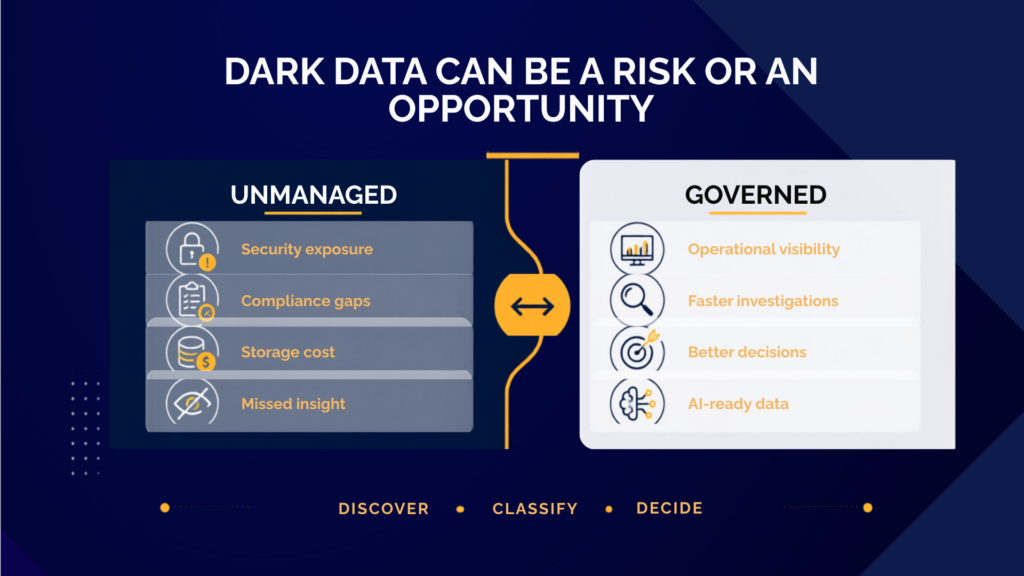
Dark data is not risky simply because it is unused. The risk comes from not knowing or governing it. An organization cannot protect, retain or delete information consistently when it does not know where that information is, what it contains or who owns it.
- Security and privacy exposure. Forgotten logs, files, and backups may contain personal data, credentials, IP addresses, customer records, or trade secrets.
- Security and privacy exposure. Privacy and retention obligations can apply even when the information is not actively used. The organization still needs a lawful purpose and a defined retention period.
- Unnecessary cost. Low-value data increases storage, backup, transfer, licensing and administrative costs.
- Incomplete operational visibility. Critical evidence may exist during an outage, security incident or audit, but teams cannot find it quickly enough.
- Missed insight. Unused information can conceal customer pain points, process bottlenecks, equipment problems or emerging service needs.
- A weak foundation for AI. Unknown, biased or poor-quality information can produce unreliable models and conclusions.
The European Commission's GDPR principles include purpose limitation, data minimization, and storage limitation. Managing dark data supports these principles, although each legal situation requires its own assessment.
What value can dark data provide?
Dark data may be an untapped resource, but volume alone does not create value. Information becomes useful when it answers a real question and leads to action.
- Better operational visibility. Logs and events can reveal performance bottlenecks, repeated failures and weak points across a service.
- Faster investigations. Centralized and searchable information reduces the time needed to identify the cause of an outage or security incident.
- Predictive maintenance. Sensor and equipment data can reveal abnormal behavior before a failure or production interruption.
- Customer understanding. Feedback, searches, conversations, and user journeys can reveal repeated needs, drop-off points, and causes of dissatisfaction.
- Security and fraud detection. Access, event and behavior data can reveal unusual activity and provide evidence for investigations.
- Audit and reporting support. Properly retained records can provide evidence of what happened and help demonstrate compliance.
- AI and analytics. Relevant, classified and high-quality data can strengthen analysis and support the development of useful models.
How do you bring dark data into the light?
A dark data program should not begin with a technology purchase. It should begin with a business question and progress through a controlled lifecycle.
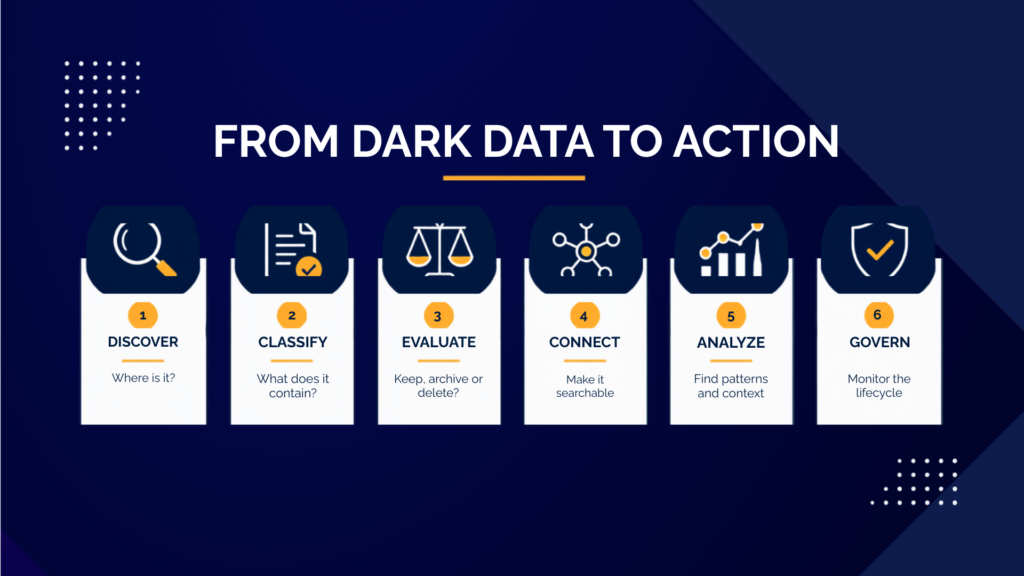
- Define the question and use case. Are you trying to reduce outages, accelerate audits, detect fraud, improve customer experience or lower storage cost? A clear scope prevents unnecessary collection.
- Inventory the sources. Identify applications, logs, cloud services, databases, files, sensors, integrations, backups and legacy systems. Interview business and technical teams as part of the discovery process.
- Assign ownership and classify the data. Record who is responsible, what the dataset contains, how sensitive and reliable it is, and which retention obligations apply.
- Decide what should happen to it. Not every dataset should be activated. Decide whether to use it, retain it, move it to a lower-cost archive or delete it securely.
- Connect and standardize selected sources. Make valuable information searchable and comparable. Add metadata, normalize timestamps and fields, and verify access controls.
- Analyze and add context. Use search, dashboards, correlation, anomaly detection and AI where appropriate. Connect technical events with a service, customer or business process.
- Turn insight into action and govern the lifecycle. Create an alert, report, workflow or decision. Continue tracking usage, quality, cost and retention so new dark data does not accumulate unnoticed.
What role do AI and machine learning play?
Machine learning and AI can process large datasets faster than people. They can help classify files, detect personal information, transcribe audio, identify anomalies and surface repeated patterns.
More data does not automatically produce better AI. A model needs information that is relevant, sufficiently described, reliable and lawful to use. Otherwise, a larger dataset can simply introduce more noise, bias and false conclusions.
People must still define the objective, evaluate fitness for use and decide how to act on the result. AI accelerates the work. It does not resolve ownership, privacy, data quality or lifecycle decisions on the organization's behalf.
How are dark data, log management and observability connected?
A large share of technical dark data comes from logs and telemetry. Systems continuously generate evidence about events, errors, access, performance and user journeys. When this information is collected inconsistently, isolated between teams or impossible to search and correlate, it creates blind spots.
Log management fundamentals explain how logs can be collected, retained and analyzed. Splunk observability brings logs, metrics and traces together so teams can investigate problems that were not predicted in advance.
The objective is not to send every possible data source into one platform. Sources should be selected according to the use case, value, sensitivity, retention requirement and cost. Good observability reduces blind spots and noise at the same time.
Splunk can make machine and log data searchable, correlate events across sources, and support dashboards, alerts, and analytics. Managed log management and archiving can keep active data available for fast investigation while moving long-term records to more cost-efficient storage. A platform alone does not solve ownership, quality or governance.
Our customer case on log and data management with Splunk. shows this distinction in practice. Distributed audit logs were brought into a centralized and searchable architecture where operational analytics and long-term immutable archiving serve different needs.
Where should an organization start?
The first step does not need to be a company-wide dark data program. Start with a limited environment where missing visibility creates a clear operational, security or compliance problem.
- Choose one critical service, process or audit requirement.
- List the known and suspected data sources connected to it.
- Identify ownership, permissions, sensitivity and retention needs.
- Decide which information supports action and which represents only cost or risk.
- Make valuable data searchable and connect it to the right business context.
- Measure whether the change improved visibility, response time, cost or compliance.
Turn dark data into governed data
Dark data can contain valuable evidence, but it can also increase cost and risk. The goal is not to illuminate everything at any price. The goal is to gain enough visibility to know what information exists, why it is retained and what should happen to it.
Once sources, ownership, quality, permissions and lifecycle are clear, an organization can make better decisions. Some data becomes useful for analytics and AI. Some is retained securely. Some is deleted. Each can be the correct outcome.
Frequently asked questions about dark data
What does dark data mean?
Dark data is information an organization collects, processes or stores but does not actively use for analytics, decision-making or operational improvement.
What are examples of dark data?
Examples include unanalyzed logs, IoT sensor data, emails, call recordings, old documents, backups and information left in retired systems.
Is dark data the same as unstructured data?
No. Unstructured data describes a format. Dark data describes limited visibility or use. A fully structured database can also become dark data.
Why is dark data a security risk?
Unknown data may not receive the right access controls, protection, retention rules or monitoring. It can contain personal information and other sensitive records.
How can organizations use dark data?
First discover, classify and evaluate it. Valuable information can then support analytics, observability or AI. Low-value data should be archived or deleted according to defined policies.
Can Splunk help manage dark data?
Splunk can make machine and log data searchable, connect sources, and support visualization, alerts and analytics. Clear use cases, ownership, privacy controls and lifecycle governance are still required.
Facebook
Twitter
LinkedIn