
When Do Companies Need Observability Expertise?
Key takeaways
- Companies usually need observability expertise when applications become difficult to understand across multiple services, teams, cloud platforms, or external providers.
- An observability expert helps turn logs, metrics, traces, and other telemetry into evidence engineers can actually use during investigations.
- Observability works best when it is considered during architecture and development, rather than added only after a production problem appears.
- The expertise can sit within development, DevOps, platform engineering, or SRE. A dedicated observability engineer is useful when the work becomes too specialised or time-consuming for those teams to maintain.
- AI observability adds new requirements, including visibility into model calls, retrieval, tool execution, workflow failures, and operating costs.
Introduction
Your developers build the application. Your cloud team runs the infrastructure. Platform engineers provide the tools that help both teams work efficiently. But when a customer cannot complete a transaction, and the issue crosses several services, who can explain what actually happened? It is observability expertise that allows us to get to the heart of the problem.
Companies need stronger observability capabilities when understanding a service requires evidence from several systems, teams, or providers, but existing monitoring tools cannot connect that evidence clearly enough. A dashboard may show that something is wrong, for example, without explaining where the problem started, which customer journey is affected or which team should investigate it.
For CIOs and CTOs, the question is therefore not simply whether the organisation needs another monitoring tool. It is whether teams can understand and troubleshoot the digital services the business depends on. If failures take too long to investigate, releases create uncertainty, or operating costs are difficult to explain, stronger observability capability may be needed.
That does not always mean hiring a dedicated observability engineer. Depending on the environment, the right approach may be to develop existing engineers, establish clearer ownership, or bring in specialist observability support for a particular project or capability gap.
What does an observability expert actually do?
An observability expert helps teams understand how applications and infrastructure behave by making operational data useful for investigation and decision-making.
The work often includes application instrumentation, connecting logs, metrics, and traces, designing telemetry pipelines, improving alerts, and creating consistent observability practices across engineering teams. Logs tell teams what happened, metrics show how a system is behaving over time, and traces follow requests across services. Used together, these signals provide much more context than isolated monitoring data.
Consider a slow customer portal. The application itself may be running normally, while a request is waiting on an identity provider, database, or external API. An observability engineer helps make that path visible so the team can identify where time is being spent and give the responsible service owner useful evidence.
Distributed tracing is particularly useful in this type of environment because it allows teams to follow requests across service boundaries. The real value, however, is not the trace or dashboard itself. It is giving engineers a dependable way to answer operational questions when something goes wrong.
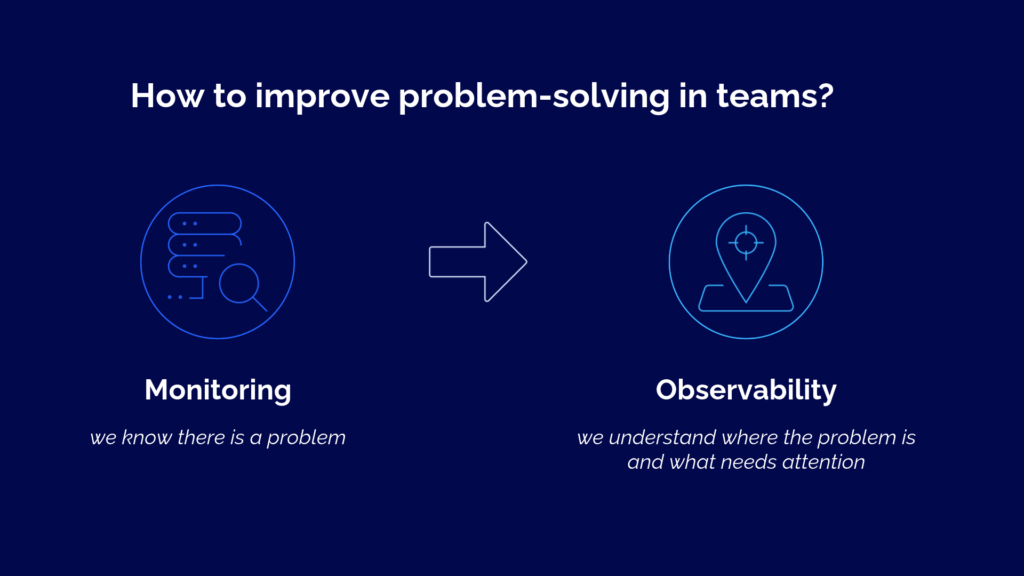
Good observability should help teams move from “we know there is a problem” to “we understand where the problem is and what needs attention.”
When does a company need observability expertise?
There is no company-size threshold that determines when observability expertise becomes necessary. A small company operating one highly critical digital service may have a stronger need than a much larger organisation with relatively straightforward systems and experienced engineering teams.
A better indicator is the gap between the complexity of the environment and the team’s ability to understand it.
- Applications have more dependencies. A customer journey may cross application services, queues, cloud infrastructure, and external providers. Teams can monitor each component individually but struggle to understand the complete journey when something fails.
- Engineering is changing faster than operational visibility. Cloud migrations, Kubernetes adoption, and a growing number of development teams can introduce new services and dependencies faster than instrumentation and investigation practices evolve.
- Incidents require too much manual investigation. Teams repeatedly search through logs, involve several people, and spend significant time deciding where the issue started. Alerts identify symptoms, but provide little information about ownership or customer impact.
- Telemetry itself requires ongoing engineering. As the volume of operational data grows, collection, retention, query performance, and cost become continuing concerns. At that point, observability is no longer an occasional configuration task; it becomes part of the engineering platform.
These are usually stronger signals than company size. If teams spend more time assembling evidence than solving the underlying problem, it is worth reviewing the organisation’s observability capability.
Where does observability fit across engineering teams?
Observability is not owned by one type of engineering team. It overlaps with software development, cloud infrastructure, DevOps, platform engineering, SRE, and increasingly AI and data engineering.
| Engineering area | Where observability expertise contributes |
|---|---|
| Software development | Instrument applications, connect requests across services, and make errors easier to investigate. |
| Cloud and infrastructure | Connect application behaviour with compute, network, storage, and container signals. |
| DevOps and release engineering | Make deployment and pipeline failures visible and compare service behaviour before and after releases. |
| Platform engineering | Provide shared telemetry collection, instrumentation standards, and self-service investigation tools. |
| Site reliability engineering (SRE) | Support service indicators, reliability targets, and actionable alerts. |
| Identity and access management (IAM) | Investigate authentication latency and failures while protecting sensitive identity data. |
| AI and data engineering | Follow model calls, retrieval, tool execution, and data-pipeline dependencies. |
This should be viewed as a practical division of responsibilities rather than a fixed organisation chart.
An SRE, platform engineer or senior developer may already handle much of the required observability work. A dedicated observability specialist becomes more useful when the depth, scale, or ongoing workload exceeds what those teams can reasonably maintain alongside their other responsibilities.
Bring observability into development before production
One of the most practical improvements a company can make is to think about observability before an application reaches production.
When the service is important or technically complex, observability expertise should be involved during architecture and planning. Teams can identify the most important user journeys, dependencies, and service owners, and decide which questions they must be able to answer if the service slows down or fails.
During development and testing, the required telemetry can then be implemented and verified. Can engineers follow a request across its dependencies? Does a failed transaction produce enough evidence to understand the problem? Does an alert reach the right owner with enough context to act?
After deployment, the same telemetry supports release validation, incident investigation, and ongoing service improvement. If an incident exposes a visibility gap, that finding can be fed back into development rather than accepted as an unavoidable monitoring limitation.
Take a customer portal as an example. Before development is complete, the team might decide that login and transaction completion are critical journeys. During testing, they can deliberately introduce a slow dependency and verify whether the telemetry shows where the delay occurs. After release, the same signals can be used to check whether those customer journeys continue to perform as expected.
This makes observability part of the software lifecycle instead of something added only after the first serious production incident.
How AI expands the need for observability expertise
AI introduces another layer of complexity because engineers need to understand not only whether an application is running, but what is happening throughout an AI workflow.
Consider a customer-service assistant. Before answering a question, it may retrieve customer information, search documents, call an AI model, and use another system to complete an action. If the assistant becomes slow or fails, knowing that the application server is healthy does not explain which step caused the problem. But AI observability goes much further than that.
Teams may need to understand how much time is spent retrieving information, waiting for a model, or calling external systems. If a workflow fails, they need evidence showing whether the cause was a failed request, timeout, access issue, or repeated retry.
Cost also becomes part of the investigation. Model usage, token consumption, and repeated calls can increase the cost of an AI service even when it remains technically available.
For example, an AI assistant that repeatedly retries a failing external request may take longer to respond while consuming more resources. Connected telemetry can reveal that pattern and help engineers determine whether the application logic, dependency, or AI workflow needs to change.
Learn how AI, observability and
software development work
together in a real-life project
How should companies build observability capability?
The right approach starts by identifying the actual gap:
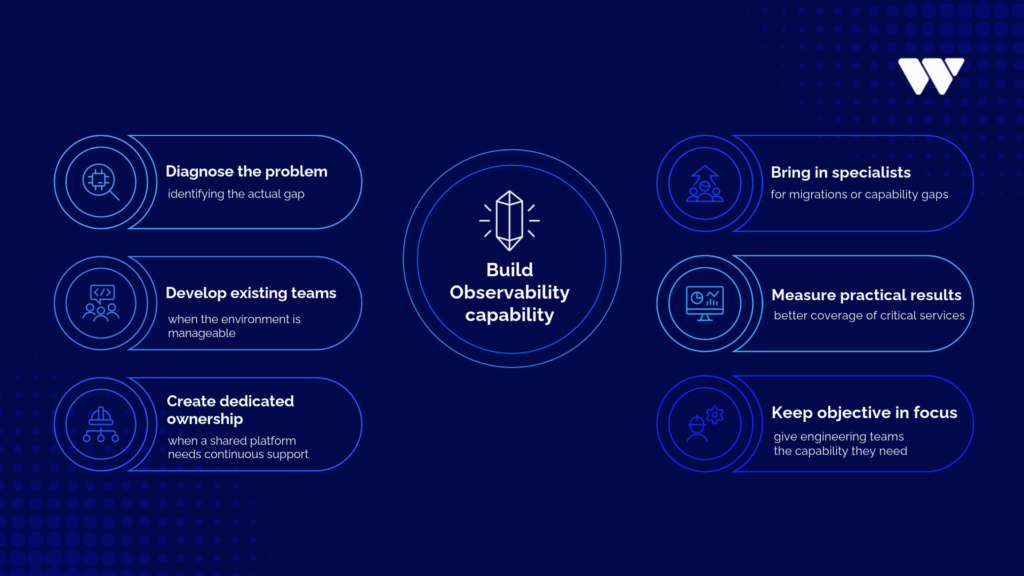
- Diagnose the specific problem first. A company struggling with application instrumentation has a different problem from one that already collects large volumes of telemetry but lacks consistent ownership. A business introducing AI services may need capabilities its current application monitoring does not provide.
- Develop existing teams when the environment is manageable. If engineers have the necessary time and knowledge, that may be enough. Observability practices can sit naturally within development, DevOps, platform engineering, or SRE.
- Create dedicated ownership when a shared platform needs continuous support. When several teams depend on a shared observability platform that requires ongoing engineering, governance, and support, someone needs responsibility for telemetry standards, instrumentation quality, retention, and the overall reliability of the environment.
- Bring in specialist support for migrations or capability gaps. When the organisation faces a migration, implementation, or gap the internal team has not handled before, the engagement should include clear deliverables and knowledge transfer so the organisation can keep improving afterwards.
- Keep the objective in focus. The goal is not to create an observability team simply because the technology exists – it is to give engineering teams the capability they need to understand important services and resolve problems efficiently.
- Measure results in practical terms. For leadership, success should be visible as better coverage of critical services, more useful alerts, less time spent gathering incident evidence, and a clearer understanding of operational costs.
Understand where your organisation needs observability expertise
Observability is most valuable when it helps people answer real operational questions. The goal is not to create more dashboards or collect telemetry simply because it is available.
Companies need observability expertise when applications, cloud environments, and digital services become difficult to understand with existing tools and practices. As systems become more distributed and AI workflows introduce new dependencies, maintaining that visibility requires more deliberate engineering.
The right capability may come from an existing SRE or platform team, a dedicated observability engineer, or an external specialist. What matters is that the organisation has clear ownership and enough expertise to make its operational data useful.
Observability Playbook
WeAre’s Observability Playbook is a practical guide for IT, DevOps, platform, and business teams that want to understand how observability helps improve visibility, reduce downtime, and connect technical performance to business outcomes. It explains how logs, metrics, and traces work together, why observability matters in modern distributed environments, how mature observability practices companies have, and how organisations can move step by step from reactive troubleshooting toward faster incident response, shared visibility, and stronger operational trust.


Conclusion
Companies need observability expertise when their systems become harder to understand than their existing monitoring practices can support. This often happens as applications become more distributed, cloud environments grow, more engineering teams share infrastructure, or AI introduces new workflows and operating costs.
The answer is not automatically to hire a new specialist. Existing DevOps, SRE, development, or platform teams may be able to provide the capability if they have enough time and knowledge. Dedicated ownership or external expertise becomes more valuable when observability requires deeper engineering, consistent governance, or ongoing platform management.
The most practical place to start is with an important service and a real operational problem. If your teams cannot easily explain what happened, where it happened, and who needs to act, improving observability should be part of the engineering roadmap.
About WeAre Solutions Oy
WeAre Solutions Oy is a Finnish observability-focused consultancy and a leading Splunk Elite Partner in the Nordics. We specialize in observability and monitoring (using Splunk), Atlassian services (Jira), and software development. Founded in 2016 and headquartered in Helsinki, our mission is to turn observability into a competitive advantage for organizations.
At WeAre, we help organizations assess their Splunk environments, identify improvement opportunities, and align performance with real business needs. You can start with an observability assessment to understand your current state, or contact our team for a free consultation.
Free Observability
Assessment and Consultation
30-minute expert consultation
Custom improvement roadmap
Detailed assessment report
FAQs
Do companies need a dedicated observability engineer?
Not always. Companies need clear ownership and appropriate observability expertise, but that capability may already exist within platform engineering, SRE, DevOps, or development teams. A dedicated observability engineer becomes more useful when shared telemetry systems, complex instrumentation, or ongoing governance require substantial specialist work.
What does an observability engineer do?
An observability engineer helps teams collect, connect, and use operational telemetry such as logs, metrics, and traces. Their work may include application instrumentation, telemetry pipelines, alerting, distributed tracing, platform design, and helping engineering teams investigate problems more effectively.
Is observability part of DevOps or platform engineering?
It can be part of both. DevOps teams use operational feedback to improve software delivery, while platform engineering teams may provide shared observability tools, telemetry standards, and self-service capabilities. Specialist observability expertise supports these teams when deeper knowledge is required.
When should observability be added to an application?
Observability should ideally be considered during architecture and development, particularly for important or complex services. Defining critical journeys and required telemetry early makes it easier to test whether the necessary evidence will be available before the application reaches production.
What changes with AI observability?
AI observability adds visibility into areas such as model calls, retrieval, tool execution, workflow dependencies, token consumption, and operating costs. Teams may also need to connect technical telemetry with evaluations of AI output quality.
How can a company tell if its observability needs improvement?
A useful test is to review a recent incident. If teams could not follow the problem across dependencies, spent significant time gathering evidence, or struggled to identify ownership and customer impact, there is likely an observability gap worth addressing.
Facebook
Twitter
LinkedIn